Unvented attics with exposed foam
The most common case. Foam at the roof deck, nothing over it, and a thermal barrier required before the space can be signed off.
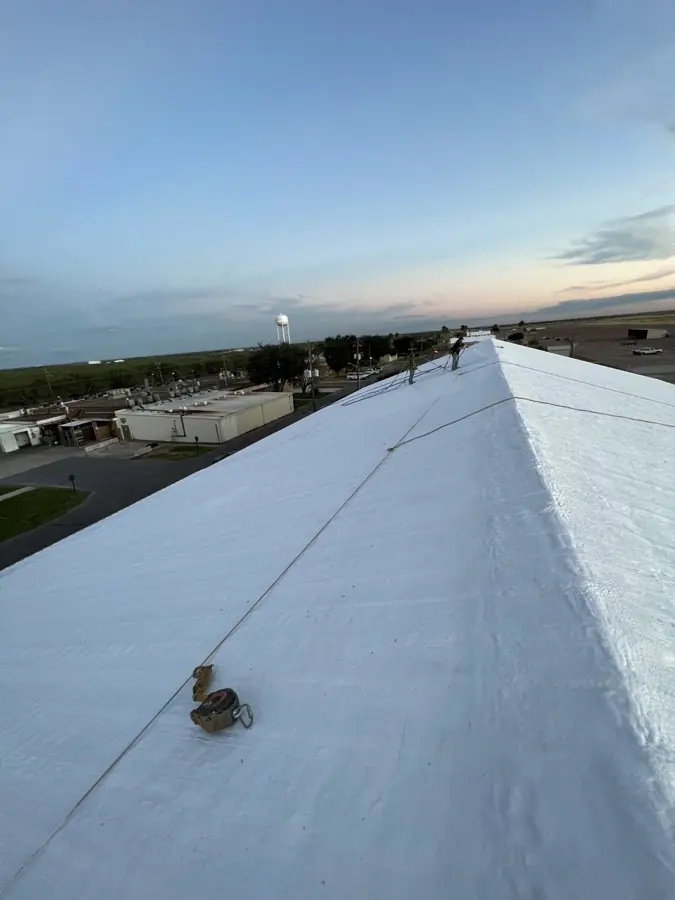
Code-compliant fire protection sprayed over exposed foam — so the attic, crawl space or garage passes inspection without hanging drywall over it.
Huntsman’s intumescent coatings have completed NFPA 286 testing and are approved as an interior finish system in accordance with the IRC and IBC, which omits the code’s prescriptive thermal barrier requirement.
Here is what that means if you own the building. Exposed spray foam normally has to be separated from the occupied space by a prescriptive thermal barrier — in practice, half-inch gypsum board. That is fine in a finished room. It is a real problem in an attic, a crawl space or an unfinished garage, where framing drywall around every rafter and joist is slow, awkward and expensive, and sometimes not physically possible.
An approved intumescent coating satisfies the code through the interior finish path instead. The foam stays exposed, the coating goes over it, and the assembly complies. That is the entire commercial case for the product.
These non-flammable coatings are approved for use on top of a number of Huntsman’s spray foam insulation products.
Intumescent coatings starve a fire, preventing oxygen from reaching the spray foam insulation. The coating is 100% non-toxic, drain-safe, and non-fuming, and is designed for walls, attics, and crawlspaces.
The most common case. Foam at the roof deck, nothing over it, and a thermal barrier required before the space can be signed off.
Encapsulated crawl spaces where drywall is impractical and the foam has to stay exposed to stay serviceable.
Spaces that are insulated but never finished out, where the owner does not want to pay to drywall a room they use for storage.
Commercial and industrial buildings where the foam is sprayed to the underside of the deck and stays exposed permanently.
Any assembly where a thermal barrier or ignition barrier is required over foam. Different assemblies carry different requirements — Premium Icynene Ultra 50, for instance, is ignition-barrier-free in unventilated attics, which is a separate question from a thermal barrier. We specify the correct one per job instead of coating everything by default.
| Product type | Non-flammable intumescent fire-protective coating |
|---|---|
| Fire test | NFPA 286 testing completed |
| Code approval | Approved as an interior finish system in accordance with the IRC and IBC, which omits the prescriptive thermal barrier requirement |
| Applied over | Approved for use on top of a number of Huntsman’s spray foam insulation products |
| Mechanism | Starves a fire, preventing oxygen from reaching the spray foam insulation |
| Toxicity | 100% non-toxic, drain-safe and non-fuming |
| Emissions | Meets LEED, AQMD and EPA VOC requirements |
| Designed for | Walls, attics and crawlspaces |
| Documented systems | Blazelok TBX, DC315 and No Burn — see technical documents below |
Published by the manufacturer. Every link opens in a new tab.
For architects, builders and inspectors — the paperwork that gets an assembly approved. Bring these to plan review; we will supply the rest of the submittal package for your project.
Building code normally requires exposed spray foam to be separated from the living space by a prescriptive thermal barrier, most commonly half-inch gypsum board. In an attic, crawl space or unfinished garage, hanging drywall is often impractical or expensive. An approved intumescent coating satisfies the code through the interior finish path instead, so the assembly passes without the drywall.
Intumescent coatings starve a fire, preventing oxygen from reaching the spray foam insulation. The coatings themselves are entirely non-flammable.
The coating is 100% non-toxic, drain-safe, and non-fuming, and it meets LEED, AQMD, and EPA VOC requirements. It is designed for walls, attics and crawlspaces.
Not necessarily. Premium Icynene Ultra 50 is ignition-barrier-free in unventilated attics, which is a different requirement from a thermal barrier and applies to a specific assembly. Different assemblies carry different requirements, and an inspector may call for a thermal barrier or an ignition barrier depending on the space. We specify the correct one per job rather than applying coating everywhere by default.
Tell us what the assembly is and what was called out. The estimate is free, it happens on site, and we will tell you straight whether you need coating or not.
Blazelok, Icynene, Heatlok, and Coatlok are trademarks of Huntsman Building Solutions. DC315 and No Burn are trademarks of their respective owners. Panda Insulation LLC is an independent applicator. Product data is published by the manufacturer and is provided here for reference.